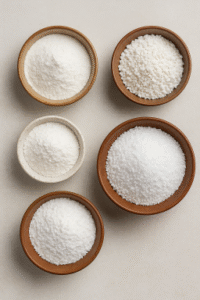
Top-down view of various food-grade phosphate powders (SAPP, STPP, TSPP) in small ceramic bowls on a neutral background, illustrating ingredients used in meat, seafood, bakery, and dairy applications.
Quick Navigation
1) Why phosphates still matter in 2025
From consistent texture and stable yield to pH control and mineral management, food grade phosphates remain foundational in meat, seafood, bakery, dairy and beverages. When correctly selected and dosed, they help extract myofibrillar proteins (for better binding), improve water-holding capacity, stabilize emulsions, and tune leavening timing.
2) Know your types & codes (E-numbers)
| Category | Typical Examples | Common Code | Key Uses | On-site link |
|---|---|---|---|---|
| Orthophosphates | Sodium phosphates (mono/di/tri-; E339) | E339 | pH control, buffering, mineral fortification | SAPP (product) |
| Pyrophosphates | SAPP (Sodium Acid Pyrophosphate) | E450(i) | Leavening acid; pH & colour control in select systems | SAPP (product) |
| Pyrophosphates | TSPP (Tetrasodium Pyrophosphate) | E450(iii) | Buffering, chelation, dispersion | TSPP (product) |
| Polyphosphates | STPP (Sodium Tripolyphosphate) | E451(i) | Myofibril extraction, WHC, texture optimisation | STPP (product) |
Tip for headings: include E-codes and common abbreviations (SAPP, STPP, TSPP). These are the exact terms many R&D buyers and spec reviewers search for.
3) Top 10 applications (snackable summaries)
- Meat & poultry: Yield and bind you can measure — Polyphosphates (esp. STPP) boost ionic strength and facilitate myofibrillar extraction, improving water-holding capacity and slice integrity in low-salt systems. Start with small brine trials and quantify cook loss vs. control.
- Seafood & fish: Drip-loss control in thaw/retort — Proper phosphate pre-treatments help mitigate drip during thawing and keep fillets firm. Pair with good cold-chain discipline for best effect.
- Bakery: Timing the rise — SAPP grades (“fast / medium / slow”) let you schedule CO₂ release to match batter rest and oven spring, reducing collapse and coarse crumb. Validate with neutralizing value and target batter pH.
- Dairy & processed cheese: Melt, flow, stability — Phosphate emulsifying salts aid protein dispersion and emulsification; switch ratios to tune meltability and sliceability.
- Beverages & water: Sequestration for clarity — Chelation of Ca²⁺/Mg²⁺ reduces haze and scale in beverage systems and processing lines; maintain sensory neutrality.
- Canned & retorted veg: Colour/firmness retention — Select salts help preserve colour during heat treatment and limit textural breakdown.
- Frozen meals: Freeze-thaw resilience — Manage ice-crystal damage and syneresis; focus on dosage discipline and matrix compatibility.
- Nutrient systems: Fortification + functional lift — Orthophosphates provide both mineral fortification and buffering control.
- Emulsions & sauces: Phase stability — Phosphates improve oil-in-water stability, reduce separation, and assist pH buffering in sensitive emulsions.
- Process robustness: Cost-to-performance wins — In high-volume lines, predictable batching and reduced rework often outweigh label-space considerations; keep clean-label alternatives ready for comparison.
Evidence pointers you can show buyers
- FDA eCFR §182.1087: Sodium acid pyrophosphate (SAPP) — GRAS when used in accordance with GMP.
- EFSA (2019) re-evaluation of phosphates (E338–E341, E343, E450–452) — latest consolidated EU scientific opinion.
- Codex GSFA Database — check provisions by additive (INS/E-number) and food category.
- FDA GRAS Overview — program background and databases.
4) Smart selection & supplier checklist (copy this into your RFQs)
- Grade & specs: food-grade certificate, FCC alignment, heavy metals, LOI, pH/assay, solubility profile.
- Function vs. matrix: for meat/seafood, test brine clarity and protein extraction; for bakery, match SAPP reaction profile to batter time and oven spring.
- Process fit: dissolution, dusting, hygroscopicity, and dosing consistency in your mixing/feeding equipment.
- Regulatory traceability: supplier should provide statements for US/EU/China and support label drafting (common names & E-numbers where applicable).
- Technical support: application notes, dose-response data, pilot trial design, and troubleshooting SOPs.
- Sustainability & logistics: packaging options, port availability, lead times, stock strategy.
5) Regulatory & safety at a glance (FDA / EFSA / Codex)
United States: Many phosphate salts are regulated under 21 CFR Parts 182/184; e.g., SAPP is listed at §182.1087 as GRAS when used in accordance with GMP. For broader background and databases, see the FDA GRAS overview.
European Union: EFSA’s 2019 re-evaluation consolidates exposure and safety for E338–E341, E343, E450–E452; compliance also follows Regulation (EC) No 1333/2008 and annexes for use levels/categories.
International (Codex): Use the GSFA database to verify additive provisions by INS number and food category (handy for export formulations and multi-market labels).
6) Mini-FAQ
Q1. Are phosphates “safe” in food?
Safety depends on salt type, dosage, and food category. In the US, several are GRAS with GMP conditions; in the EU, EFSA has published a consolidated opinion and E-number framework. Always check the exact regulation for your market and category.
Q2. How do I pick the “right” SAPP for bakery?
Match the reaction rate (fast/medium/slow) to your batter rest time and target oven spring. Calibrate with neutralizing value and final pH; validate crumb structure and volume in pilot runs.
Q3. Will phosphates affect flavour or colour?
They can, if overdosed or mismatched. Control pH, use sequestration wisely, and consider blending with citrate/acetate systems when needed. Sensory verification is essential.