Dicalcium phosphate, commonly called DCP, is an important calcium phosphate ingredient used in toothpaste, oral care products, food, feed and pharmaceutical applications. In dental care, dicalcium phosphate is mainly used as a mild abrasive, polishing agent, filler and calcium phosphate source.
For toothpaste manufacturers and oral care brands, DCP helps clean the tooth surface mechanically, supports toothpaste texture and provides a stable mineral-based powder ingredient. For buyers, the key is to choose the correct grade, especially when the application is toothpaste or dental care.
This guide explains how dicalcium phosphate is used in dentistry, how dental grade DCP differs from food grade or feed grade material, and what specifications and documents buyers should check before purchasing.
What Is Dicalcium Phosphate?
Dicalcium phosphate is a calcium salt of phosphoric acid. It is also known as dibasic calcium phosphate, calcium hydrogen phosphate or calcium hydrogen orthophosphate. Its basic chemical formula is CaHPO4.
In the food additive system, dicalcium phosphate is identified as E341(ii) or INS 341(ii). It belongs to the calcium phosphate family, together with monocalcium phosphate E341(i) and tricalcium phosphate E341(iii).
| Item | Information |
|---|---|
| Product Name | Dicalcium Phosphate |
| Common Abbreviation | DCP |
| Other Names | Dibasic calcium phosphate, calcium hydrogen phosphate |
| E Number / INS Number | E341(ii) / INS 341(ii) |
| CAS No. | 7757-93-9 |
| Chemical Formula | CaHPO4 |
| Appearance | White powder or granules |
| Solubility | Insoluble or slightly soluble in water; soluble in dilute acid |
| Main Uses | Toothpaste abrasive, food additive, feed mineral source, pharma excipient |
Related product: Dicalcium Phosphate Dihydrate Dental Grade E341(ii)
Why Is Dicalcium Phosphate Used in Toothpaste?
Dicalcium phosphate is used in toothpaste because it can help clean and polish the tooth surface without being too aggressive when the correct dental grade and particle size are selected.
In toothpaste formulation, DCP mainly works through physical cleaning. It does not need to be described as a medicine or antibacterial ingredient. Its value is mainly related to abrasive performance, polishing effect, texture and formulation stability.
| Function in Toothpaste | How DCP Helps | Buyer Consideration |
|---|---|---|
| Mild Abrasive | Helps remove plaque film and surface stains through mechanical cleaning | Particle size and abrasivity must be controlled |
| Polishing Agent | Helps improve tooth surface cleaning and smoothness | Dental grade quality is important |
| Filler | Provides body and structure to toothpaste paste or powder systems | Bulk density and texture should match the formula |
| Calcium Phosphate Source | Provides calcium and phosphate components in the formula | Compatibility with other ingredients should be tested |
| Flow and Processing Support | Helps support powder handling before toothpaste mixing | Moisture, particle size and flowability matter |
Dicalcium Phosphate Dihydrate vs Anhydrous Dicalcium Phosphate
Dicalcium phosphate is commonly supplied in two main forms: dicalcium phosphate dihydrate and anhydrous dicalcium phosphate. Both are calcium phosphate materials, but they are not always interchangeable.
| Item | Dicalcium Phosphate Dihydrate | Anhydrous Dicalcium Phosphate |
|---|---|---|
| Common Name | DCPD | DCPA |
| Formula | CaHPO4·2H2O | CaHPO4 |
| Water of Crystallization | Contains crystal water | Anhydrous form |
| Typical Use | Toothpaste, oral care, food, feed and pharma applications depending on grade | Food, feed, tablet excipient and industrial applications depending on grade |
| Buyer Focus | Particle size, abrasivity, whiteness, heavy metals and dental compatibility | Assay, moisture, flowability, particle size and grade standard |
For toothpaste and oral care products, buyers often request dicalcium phosphate dihydrate dental grade. However, the exact selection depends on the toothpaste formula, abrasive requirement, fluoride system, mouthfeel and processing method.
Related products: Dicalcium Phosphate Dihydrate Dental Grade | Dicalcium Phosphate Anhydrous E341(ii)
What Does Dicalcium Phosphate Do in Toothpaste?
1. Helps Remove Surface Stains
Dicalcium phosphate can act as a mild abrasive that helps remove surface stains from teeth during brushing. This is a mechanical cleaning effect, not a bleaching effect.
The cleaning performance depends on particle size, hardness, shape, toothpaste formula and brushing conditions. A dental grade product should be selected to balance cleaning ability and enamel safety.
2. Supports Toothpaste Polishing
DCP can help polish the tooth surface and improve the smooth feeling after brushing. This is one reason it is used in toothpaste and tooth powder formulations.
For oral care brands, polishing performance should be tested in the final formulation, because abrasivity can change when DCP is combined with other ingredients.
3. Provides Toothpaste Body and Texture
Dicalcium phosphate can work as a mineral filler in toothpaste. It helps build toothpaste body, consistency and solid content.
For toothpaste manufacturers, the powder should have stable particle size, whiteness and bulk density to support consistent processing.
4. Provides Calcium and Phosphate Components
Dicalcium phosphate contains calcium and phosphate, which makes it useful in mineral-based oral care formulations. However, buyers should avoid exaggerated claims. The performance of the final toothpaste depends on the complete formula, not only one ingredient.
5. Supports Powder Handling Before Mixing
Before toothpaste production, powdered raw materials must be easy to handle, weigh, mix and disperse. DCP quality affects flowability, dusting, mixing behavior and final toothpaste texture.
Is Dicalcium Phosphate a Remineralizing Ingredient?
Dicalcium phosphate contains calcium and phosphate, so it is often discussed in relation to enamel and mineral balance. However, in commercial toothpaste, buyers should be careful with direct remineralization claims unless the finished product formula has proper evidence and regulatory support.
For B2B sourcing, it is more accurate to describe DCP as a dental abrasive, polishing agent, filler and calcium phosphate ingredient. Any tooth-strengthening or remineralization claim should be evaluated at the finished product level.
Is Dicalcium Phosphate Compatible with Fluoride Toothpaste?
Dicalcium phosphate may be used in oral care formulations, but compatibility with fluoride systems should always be tested. Different fluoride sources and toothpaste formulas may interact differently with calcium-containing abrasives.
Before bulk purchase, toothpaste manufacturers should confirm:
- Whether the DCP grade is suitable for fluoride toothpaste
- Which fluoride source is used in the formula
- Available fluoride stability after storage
- pH and moisture conditions
- Compatibility with binders, humectants and surfactants
- Abrasivity and mouthfeel in the final product
This is why dental grade DCP should be tested in the actual toothpaste formula before mass production.
Common Dental and Oral Care Applications
Dicalcium phosphate can be used in different oral care products depending on grade, particle size and formulation requirement.
| Application | Role of DCP | Key Requirement |
|---|---|---|
| Toothpaste | Abrasive, polishing agent and filler | Dental grade, controlled particle size and abrasivity |
| Tooth Powder | Cleaning powder and mineral filler | Flowability, whiteness and mouthfeel |
| Dental Polishing Paste | Polishing and cleaning support | Controlled abrasive profile |
| Oral Care Tablets | Filler, mineral ingredient and processing support | Compression behavior and compatibility |
| Specialty Oral Care Formulas | Calcium phosphate ingredient and texture support | Formula-specific testing |
Dicalcium Phosphate in Food, Feed and Pharma Applications
Although this article focuses on dentistry, dicalcium phosphate is also used in food, animal feed and pharmaceutical applications. Buyers should choose the correct grade according to the final use.
| Application Field | Common Use | Required Grade |
|---|---|---|
| Food | Anti-caking agent, acidity regulator, raising agent, stabilizer and mineral source | Food grade E341(ii) |
| Feed | Calcium and phosphorus source for animal nutrition | Feed grade |
| Dental | Toothpaste abrasive, polishing agent and filler | Dental grade |
| Pharmaceutical | Tablet filler, diluent or excipient depending on formulation | Pharma grade or pharmacopeia-compliant grade |
| Industrial | Technical applications depending on specification | Industrial grade |
Food grade, feed grade, dental grade and pharmaceutical grade DCP should not be treated as the same product. Each application may require different purity, particle size, microbiological limits, heavy metal limits and documentation.
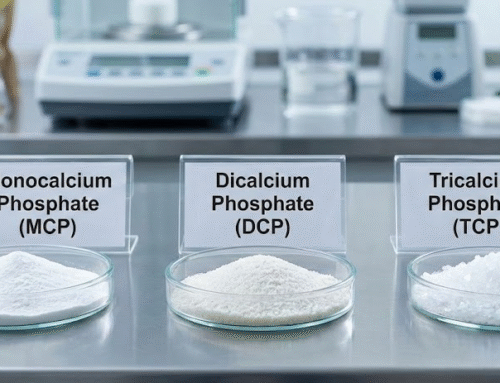
Dicalcium Phosphate vs MCP vs TCP
Dicalcium phosphate belongs to the E341 calcium phosphate family. Buyers often confuse DCP with monocalcium phosphate and tricalcium phosphate, but they are used differently.
| Product | Abbreviation | E Number | Main Feature | Common Applications |
|---|---|---|---|---|
| Monocalcium Phosphate | MCP | E341(i) | More acidic calcium phosphate; reacts with baking soda | Baking powder, bakery leavening, feed and nutrition |
| Dicalcium Phosphate | DCP | E341(ii) | Calcium phosphate with food, feed, dental and pharma applications | Toothpaste, tablets, feed, food fortification and dry mixes |
| Tricalcium Phosphate | TCP | E341(iii) | Low-solubility powder; useful as anti-caking agent and mineral source | Powdered foods, nutrition powders, dry mixes, feed and oral care |
If the buyer only asks for “calcium phosphate,” the supplier should clarify whether the application requires MCP, DCP or TCP. Choosing the wrong calcium phosphate may cause problems in pH, solubility, abrasive performance, leavening reaction, texture or regulatory compliance.
Related products: Monocalcium Phosphate E341(i) | Tricalcium Phosphate E341(iii)
Dental Grade Dicalcium Phosphate Specification: What Buyers Should Check
When sourcing dicalcium phosphate for toothpaste or oral care products, buyers should check the specification carefully. Dental applications require more than a basic chemical assay.
| Test Item | Why It Matters |
|---|---|
| Appearance | Confirms whiteness and visual consistency |
| Identification | Confirms the product is dicalcium phosphate |
| Assay | Confirms chemical content and purity |
| Calcium Content | Important for formula calculation and quality control |
| Phosphate Content | Important for mineral content and specification control |
| Loss on Drying | Reflects moisture and crystal water control |
| pH Value | Affects formulation compatibility and stability |
| Particle Size | Affects abrasivity, mouthfeel, dispersion and toothpaste texture |
| Bulk Density | Affects powder handling, filling and mixing |
| Whiteness | Important for toothpaste appearance |
| Fluoride | Important impurity control for calcium phosphate materials |
| Lead | Important heavy metal control item |
| Arsenic | Important for oral care and food-related safety requirements |
| Cadmium / Mercury | May be required by strict customer standards |
| Microbiological Limits | May be required for oral care or pharmaceutical applications |
For toothpaste production, the most important practical items are particle size, abrasivity, whiteness, pH, heavy metals and compatibility with the finished formula.
Why Particle Size and Abrasivity Are Important
Particle size is one of the most important quality factors for dental grade dicalcium phosphate. If the particles are too coarse or the abrasive profile is not suitable, the finished toothpaste may feel gritty or become too abrasive. If the particles are too fine or too soft, the cleaning effect may not meet the formulation target.
Buyers should confirm:
- Particle size distribution
- Typical abrasivity level
- Mouthfeel in toothpaste
- Dispersion performance
- Batch-to-batch consistency
- Compatibility with the toothpaste processing method
For dental products, sample testing is strongly recommended before bulk purchase.
Why Heavy Metal Control Matters
Dicalcium phosphate may be used in toothpaste, food, feed, nutrition products and pharmaceutical excipients, so heavy metal control is important.
Buyers should pay attention to:
- Lead
- Arsenic
- Cadmium
- Mercury
- Fluoride
- Other impurities required by the target market or customer specification
For oral care brands, low heavy metals and stable batch quality help reduce compliance risk and customer complaints.
Documents You Should Request from a Dicalcium Phosphate Supplier
For international sourcing, documents are as important as price. A reliable DCP supplier should provide complete technical and export documents.
| Document | Why It Matters |
|---|---|
| COA | Confirms batch quality and actual test results |
| TDS | Shows product specification, properties and applications |
| SDS / MSDS | Required for safe handling, storage and transport |
| Dental Grade Statement | Confirms suitability for oral care applications if required |
| Food Grade Statement | Required when the product is used in food applications |
| Feed Grade Statement | Required when the product is used in feed applications |
| Halal Certificate | Important for some food, oral care and export markets |
| Kosher Certificate | Required by some food and oral care customers |
| Allergen Statement | Often requested by brands and distributors |
| GMO Statement | Often required for international ingredient purchasing |
| Certificate of Origin | May be required for customs clearance |
| Packing List and Commercial Invoice | Required for import and export process |
If the product is used for toothpaste, mouthwash tablets, dental polishing paste or pharmaceutical products, additional documents may be required by the customer.
Packaging and Storage
Dicalcium phosphate is commonly supplied in 25 kg bags or customized packaging according to buyer requirements.
Recommended storage conditions include:
- Store in a cool, dry and well-ventilated warehouse
- Keep packaging sealed after opening
- Avoid moisture and contamination
- Avoid direct sunlight
- Keep away from strong odors and incompatible materials
- Follow the SDS for safe handling and storage
For oral care and pharmaceutical applications, warehouse hygiene and packaging integrity are especially important.
How to Choose a Dicalcium Phosphate Supplier
When choosing a dicalcium phosphate supplier, buyers should evaluate grade, specification, batch stability, documents and export support.
1. Confirm the Correct Grade
Dental grade, food grade, feed grade and pharma grade DCP are not the same. Always confirm the application before ordering.
2. Check Particle Size and Whiteness
For toothpaste applications, particle size, whiteness and mouthfeel are very important. Ask for sample testing before bulk purchase.
3. Request Batch COA
A batch COA should show actual test values for key items such as assay, moisture, pH, particle size and heavy metals.
4. Confirm Formula Compatibility
For toothpaste, DCP should be tested with the actual formula, including fluoride source, humectant, binder, surfactant and flavor system.
5. Check Export Experience
A supplier with export experience can help with packaging, labeling, palletizing, customs documents and shipment coordination.
Why Buy Dicalcium Phosphate from Guizhou Lvyin Biotech?
Guizhou Lvyin Biotech supplies calcium phosphates, sodium phosphates, potassium phosphates, citrates, acetates and customized phosphate solutions for international buyers.
For dicalcium phosphate, we can support:
- Dicalcium phosphate dihydrate dental grade
- Dicalcium phosphate anhydrous E341(ii)
- Food, feed, dental and related application support
- Stable batch quality and COA
- Low heavy metal control
- Particle size and specification discussion according to application
- COA, TDS, SDS and export documents
- Halal and other documents according to order requirements
- Standard 25 kg export packaging
- Export support for manufacturers, distributors and ingredient traders
If you are sourcing dicalcium phosphate for toothpaste, food, feed or pharmaceutical applications, contact us for the latest specification, COA, sample availability and quotation.
View product details: Dicalcium Phosphate Dihydrate Dental Grade
Frequently Asked Questions About Dicalcium Phosphate in Dentistry
What is dicalcium phosphate used for in toothpaste?
Dicalcium phosphate is mainly used in toothpaste as a mild abrasive, polishing agent, filler and calcium phosphate ingredient. It helps clean the tooth surface mechanically and supports toothpaste texture.
Is dicalcium phosphate the same as DCP?
Yes. DCP is the common abbreviation for dicalcium phosphate.
What is the E number of dicalcium phosphate?
The E number of dicalcium phosphate is E341(ii). It is also known as INS 341(ii).
Is dicalcium phosphate the same as tricalcium phosphate?
No. Dicalcium phosphate is E341(ii), while tricalcium phosphate is E341(iii). DCP is commonly used in toothpaste, feed, food and tablets, while TCP is often used as an anti-caking agent, mineral source and powder flow aid.
Is dicalcium phosphate a whitening ingredient?
Dicalcium phosphate can help remove surface stains through mechanical brushing and polishing. It should not be described as a chemical bleaching agent.
Does dicalcium phosphate kill bacteria?
Dicalcium phosphate is not mainly used as an antibacterial ingredient. In toothpaste, its primary role is abrasive cleaning, polishing, filling and formula structure support.
Can food grade DCP be used in toothpaste?
Not automatically. Toothpaste applications usually require dental grade DCP with suitable particle size, abrasivity, whiteness and oral care compatibility. Buyers should confirm the grade before purchasing.
What documents should I request before buying dental grade DCP?
Buyers should request COA, TDS, SDS or MSDS, dental grade statement if required, heavy metal data, particle size information, certificate of origin, packing list and commercial invoice.
Can DCP be used with fluoride toothpaste?
It depends on the fluoride source and complete toothpaste formulation. Compatibility and available fluoride stability should be tested before mass production.
Conclusion
Dicalcium phosphate is an important calcium phosphate ingredient for toothpaste and oral care products. In dentistry, its key roles are mild abrasive cleaning, polishing, filling and toothpaste texture support.
For buyers, the most important point is to choose the correct grade. Dental grade DCP should have suitable particle size, whiteness, abrasivity, low heavy metals and complete documentation.
Guizhou Lvyin Biotech supplies dicalcium phosphate products for global buyers. Contact us to request the latest specification, COA and quotation.
Request Dicalcium Phosphate COA and quotation: Contact Us