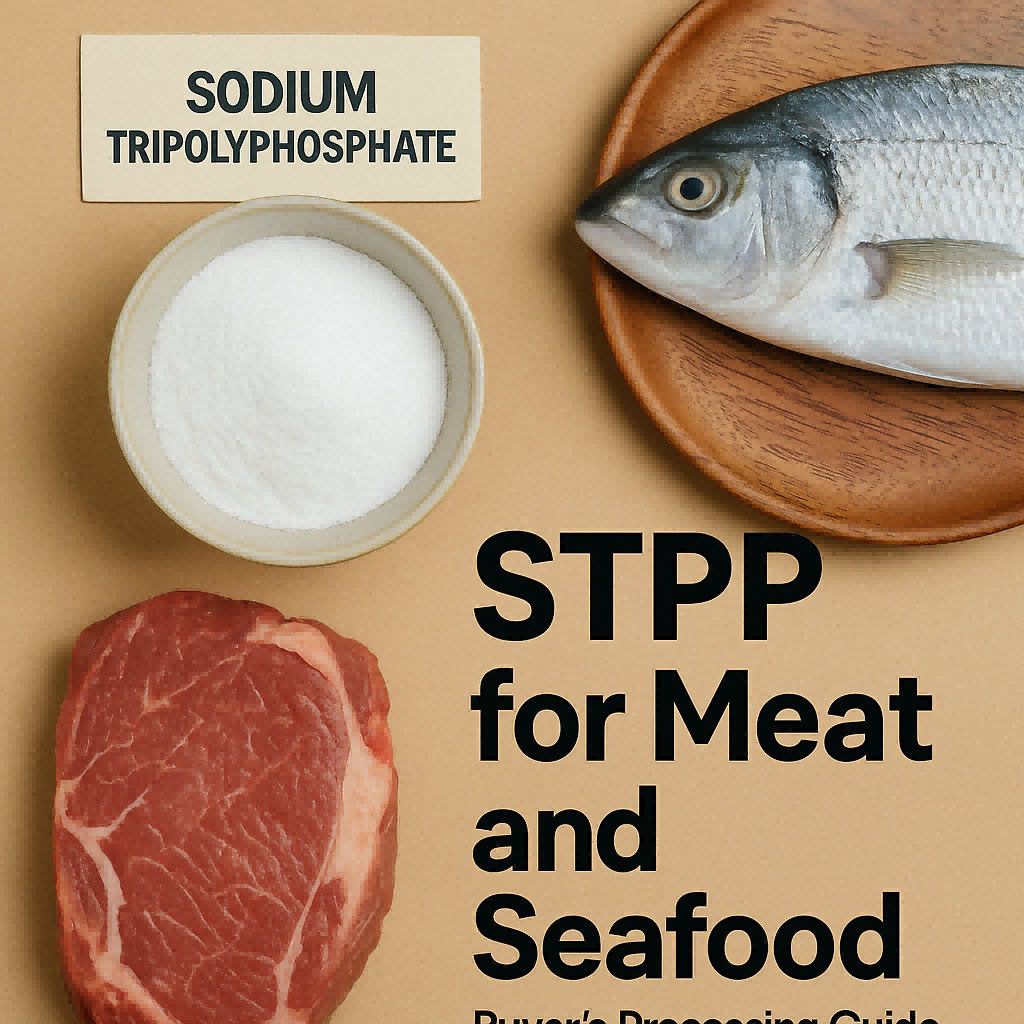
Sodium tripolyphosphate (STPP, E451(i)) is one of the most powerful functional phosphates in modern food processing.
But “STPP” is not a single uniform product: meat plants and seafood factories often need different bulk densities, dissolution speeds and performance profiles. If buyers only consider price and “food grade STPP ≥ 95%”, they can easily select the wrong material.
This article explains, from both a technical and procurement perspective, how STPP works in meat and seafood systems, where their requirements diverge, and how to select fast soluble vs normal STPP grades that fit your actual process conditions.
1) Same STPP, Different Worlds: Meat vs Seafood
On the specification sheet, STPP for meat and STPP for seafood may look almost identical:
- Chemical name: sodium tripolyphosphate
- Assay: typically ≥ 95% or ≥ 98%
- Food additive code: E451(i)
- Appearance: white powder or granules
Yet in practice, a meat plant and a seafood factory rarely have the same expectations:
- Meat brines are often prepared in dedicated tanks, sometimes with partial heating and longer mixing time.
- Seafood STPP solutions are frequently prepared directly in cold water soaking tanks, with very limited agitation.
- Meat plants care a lot about protein extraction and emulsion stability in sausages and hams.
- Seafood processors place greater emphasis on drip loss, firmness, glazing behaviour, and surface appearance.
To choose intelligently, we must first understand how STPP interacts with meat and seafood at the protein level.
2) How STPP Works in Meat Systems
Meat systems are dominated by myofibrillar proteins (myosin, actin, etc.) arranged in a structured muscle fibre network. When salt and STPP are added in the right conditions, these proteins can be partially extracted and restructured, giving the characteristic bind and sliceability of processed meats.
2.1 Shifting pH Away from the Isoelectric Point
Meat proteins have an isoelectric point (pI) around pH 5.0–5.3. At PI, the net charge is minimal and water-holding capacity is at its lowest. By slightly raising the pH above this range, STPP:
- increases net negative charge on protein surfaces,
- enhances electrostatic repulsion between filaments,
- opens up the structure and creates more space for water.
This is one of the main mechanisms behind improved juiciness and lower cooking loss in phosphate-treated meat.
2.2 Enhancing Ionic Strength and Protein Extraction
STPP, together with sodium chloride, contributes to ionic strength. When ionic strength is sufficient, salt-soluble proteins (especially myosin) move from the myofibrils into the brine phase:
- In injected or tumbled meat, these proteins form a sticky film that helps bind muscle pieces together,
- In sausages, extracted proteins encapsulate fat droplets and water, stabilising the emulsion.
2.3 Calcium / Magnesium Binding and Protein Stabilisation
STPP also chelates divalent cations such as Ca2+ and Mg2+, which can strengthen protein–protein crosslinks and cause toughness if present in excess. By moderating these ions:
- The protein network becomes more flexible,
- Heat-induced gels are less brittle,
- The final bite is more tender and uniform.
2.4 What Meat Plants Expect from STPP
In practice, meat processors typically expect a good STPP to:
- dissolve completely in brine within a predictable time,
- contribute to low cook loss and low purge in the package,
- improve sliceability and texture (no crumbling, no jelly pockets),
- remain stable when brines are stored at low temperature.
Whether the plant can accept slower-dissolving, high-density STPP depends on brine preparation conditions—especially water temperature and mixing time—which we will revisit later.
3) How STPP Works in Seafood Systems
Seafood muscle (fish, shrimp, squid) differs from red meat in several important aspects:
- higher moisture content and more delicate structure,
- different protein composition and pH,
- greater sensitivity to freezing, thawing and salt.
STPP is used to protect this delicate structure during processing and storage.
3.1 Moisture Retention and Drip Loss Control
Frozen seafood can lose moisture during:
- thawing (drip loss),
- cold storage (freezer burn, weight loss),
- cooking (shrinking, dryness).
STPP improves water binding in muscle tissue, so that:
- Thawed shrimp or fish fillets retain more weight,
- cooked products stay juicy instead of dry and fibrous,
- yield losses are reduced across the entire value chain.
3.2 Firmness, Texture and Surface Appearance
Consumers expect shrimp to be firm and bouncy, not mushy or rubbery. For fish fillets, they look for a clean, intact appearance without large gaps between muscle flakes.
Properly controlled STPP treatment can:
- keep muscle fibres closer together,
- reduce gaping in fish fillets,
- improve bite and elasticity in shrimp and squid.
3.3 Seafood-Specific Constraints
Unlike meat plants, where STPP may be added in more controlled mixing tanks, seafood operations often:
- prepare STPP solutions directly in large, cold soaking tanks,
- have limited mechanical agitation, sometimes only manual stirring,
- work under tight time pressure during receiving and glazing operations.
Under these conditions, slow-dissolving STPP is a serious problem: undissolved particles settle at the bottom,The brine concentration is uneven, and treatment is inconsistent across batches.
4) Physical Form, Bulk Density and Dissolution Behaviour
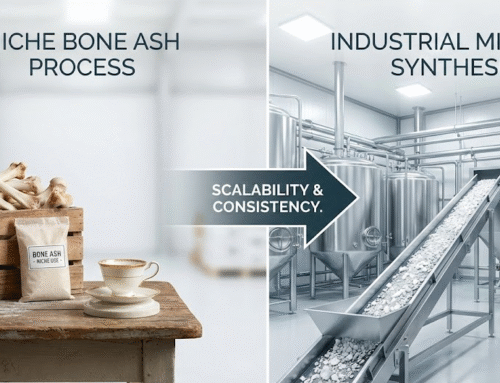
All STPP used in food has the same chemical formula. Where products differ is in their physical structure, which is largely determined by the manufacturing process.
4.1 High-Density STPP (Spray-Dried)
High-density STPP is usually obtained by spray-drying a melted phosphate mixture into small, solid spherical particles:
- particles are compact and have limited internal pores,
- they pack tightly together, leaving little void space,
- Bulk density is typically > 0.7 g/ml.
From a logistics point of view, this is attractive:
- More tonnes can be packed in the same number of bags and pallets,
- better utilisation of 20′ FCL or 40′ FCL containers,
- lower freight cost per tonne of active ingredient.
However, in cold water, this type of STPP:
- dissolves more slowly, because water only contacts the outer surface,
- easily forms lumps or “fish eyes” if added too quickly,
- may leave undissolved sediment if mixing time is insufficient.
4.2 Low-Density STPP (Dry Polymerisation, “Fast Soluble STPP”)
Low-density STPP, frequently marketed as fast soluble STPP, is produced by dry (tower) polymerisation. It has a very different microstructure:
- particles are irregular, porous and sponge-like,
- there is significant internal void volume,
- bulk density is < 0.7 g/ml, sometimes as low as 0.55–0.65 g/ml.
These structural features give low-density STPP three crucial advantages in water:
- Large effective surface area: water penetrates pores, speeding up dissolution.
- Better wetting and dispersion: fewer lumps and no thick crust around dry cores.
- Slow settling: fluffy particles stay suspended longer, improving contact with water.
The result is a product that dissolves much faster in cold brines—exactly what both meat and seafood brine systems need, but seafood processing depends on it even more.
STPP Bulk Density Classification & Selection Scenarios
When to prioritise high-density STPP (> 0.7 g/ml)
- Large-scale, highly automated, continuous production lines.
- Standardised, uniform products such as minced meat products and fish or surimi-based items.
- Plants that have dedicated brine tanks, strong agitation and sufficient mixing time.
- Projects where maximising container loading (more tonnes per FCL) is a key cost driver.
When to prioritise fast soluble, low / medium-density STPP (< 0.7 g/ml)
- Processes based on soaking, tumbling or injection in cold brine.
- Frozen shrimp, whole or butterfly shrimp, fish fillets and molluscs.
- Small and medium-scale plants with limited mixing equipment or short brine preparation time.
- Any application where undissolved particles, sediment or “fish eyes” in the brine have been a recurring issue.
Compliance reminder (example: China): in pre-prepared meat products and frozen aquatic products, the maximum usage level of STPP is commonly regulated around 5.0 g/kg (expressed as total phosphate). It is recommended to calculate and control the dosage based on the final product weight to ensure legal compliance and product safety.
5) STPP Selection Strategy for Meat Products
The right STPP for meat processing depends on the type of product, the brine system and the plant equipment. A one-size-fits-all approach often leads to inefficiencies.
5.1 Typical Meat Applications of STPP
- Injected poultry and pork: cold brine injection, followed by tumbling.
- Marinated pieces: soaking or tumbling in phosphate brine.
- Cooked hams and shoulders: high protein extraction and binding requirements.
- Emulsified sausages: fine comminution, high emulsion stability demands.
5.2 When Fast Soluble STPP is Clearly Needed in Meat
Fast soluble, low-density STPP is strongly recommended when:
- brine is mixed at ≤ 10 °C for microbiological reasons,
- Brine preparation time between batches is short (high throughput plants),
- injectors are sensitive to undissolved particles (fine needles, filters),
- The plant has a limited mixing capacity or uses simple stirring equipment.
In these conditions, high-density STPP can lead to:
- longer preparation time and labour cost,
- variable STPP concentration between brine batches,
- inconsistent yield or texture across production days.
5.3 When Normal (High-Density) STPP Can Still Work
There are meat plants where high-density STPP remains acceptable, for example:
- brine is prepared in advance, with ≥ 30–60 minutes of mixing time,
- water is slightly warmed (e.g. 20–30 °C) before cooling the brine down,
- Brine tanks have strong agitation and recirculation pumps,
- STPP dosage is modest, and other phosphates are used to fine-tune functionality.
In these circumstances, the economic advantage of higher bulk density (more tonnes per container) may justify continued use of normal STPP on meat lines.
5.4 Practical Recommendation for Meat Buyers
- Split applications by process: injection brines vs slow-mix systems.
- Use fast soluble STPP where brines are cold and change frequently.
- Consider high-density STPP only for non-critical systems with long mixing and warm water.
- Ask for plant trials with both types before committing large volumes.
6) STPP Selection Strategy for Seafood Products
Seafood processing is far less forgiving than meat when it comes to STPP dissolution. In many factories, soaking tanks are filled directly with cold water and STPP, often with only limited agitation.
6.1 Typical Seafood Applications of STPP
- Shrimp soaking: STPP is used in glazing or pre-freezing treatment.
- Fish fillet soaking: moisture and texture improvement.
- Squid and cuttlefish: firming and whitening control.
- Surimi production: used in combination with other phosphates to stabilise proteins.
6.2 Why Seafood Almost Always Needs Fast Soluble STPP
In shrimp or fish soaking operations:
- water is typically at 0–4 °C, to minimise microbial growth,
- tanks are large and deep, making mechanical agitation inefficient,
- STPP must dissolve quickly before product is added; otherwise, early batches are under-treated and final batches over-treated.
Using normal, high-density STPP in this situation leads to:
- undissolved granules lying at the bottom of the tank,
- non-uniform phosphate concentration in different tank levels,
- visible white spots on the product surface from local overdosing,
- complaints about “phosphate taste” or “soapy flavour”.
6.3 Surimi and Reformed Seafood
In surimi and restructured seafood, phosphates are part of a broader functional system with salt, cryoprotectants and proteins. Even here, fast dissolution is beneficial:
- shortens mixing time,
- reduces thermal load during hydration,
- improves consistency batch to batch.
7) Comparative Matrix: Meat STPP vs Seafood STPP Requirements
The table below summarises the main differences between typical meat and seafood needs for STPP:
| Aspect | Meat Processing | Seafood Processing |
|---|---|---|
| Raw material structure | Myofibrillar proteins; relatively robust muscle | Delicate muscle; higher moisture; easily damaged |
| Main STPP functions | Protein extraction, water binding, emulsion stability | Moisture retention, drip loss control, firmness, appearance |
| Brine preparation method | Often in dedicated tanks; mixing and temperature can be controlled | Often directly in soaking tanks; limited mixing; always cold |
| Typical water temperature | Cold to cool; sometimes slightly warmed then cooled | Cold (0–4 °C) throughout |
| Importance of fast dissolution | High (in injection brines), medium in other systems | Very high, essential for uniform treatment |
| Recommended STPP bulk density | Low-density (fast soluble) for brines; high-density possible for slow mixing | Low-density fast soluble STPP almost always required |
| Risk when using high-density STPP | Long mixing time, occasional undissolved residues | Heavy sediment, uneven treatment, visible defects on product |
| Selection priority | Balance between logistics and dissolution | Dissolution performance first, logistics second |
8) Usage Limits and Regulatory Considerations
From a legal and food safety perspective, all STPP used in meat and seafood must:
- be food grade, meeting relevant purity standards,
- comply with maximum permitted levels per product category,
- be properly declared on labels according to local rules.
Although details differ by country, several general principles apply:
- Many regulations control total phosphate (sum of different phosphates), not just STPP alone.
- Meat and seafood categories often have different maximum levels.
- STPP is commonly grouped with other phosphates (e.g. E450, E451, E452) under a shared limit.
For buyers, this means:
- You cannot simply increase STPP dosage to solve functional problems,
- You must consider the total phosphate load from all ingredients,
- You should work closely with R&D and QA when changing STPP grade or supplier.
Final responsibility for compliance rests with the food manufacturer. The role of the STPP supplier is to provide food-grade material, reliable specifications and technical support; the manufacturer must then apply it within legal limits.
9) Buyer Checklist: Key Questions Before Placing an Order
A technically informed purchasing process can prevent many production problems. Below is a checklist you can use when sourcing STPP for meat and seafood.
9.1 Questions About Application and Process
- Is the STPP for meat, seafood, or both?
- How is it used? Injection brine, soaking brine, sausage emulsion, surimi, etc.?
- At what water temperature will STPP be dissolved?
- How much mixing time and what kind of agitation are available?
- Have you experienced issues with undissolved powder, sediment, or lumps?
9.2 Questions for STPP Suppliers
- Is your STPP explicitly food grade? Which standards does it meet (e.g. FCC, EU, GB)?
- What is the bulk density range of this product?
- Is it produced by spray-drying or dry polymerisation?
- Do you have a fast-soluble, low-density STPP option for cold brine?
- Can you provide dissolution speed data in cold water (e.g. 10 °C) at 10% concentration?
- What are the typical levels of heavy metals, fluoride and insoluble matter?
- Can you provide COAs from multiple batches to show consistency?
9.3 Internal Decision Logic for Buyers
Simple decision path you can use:
- If the product is seafood → choose fast soluble, low-density STPP.
- If the product is meat injection brine with cold water → recommend fast soluble STPP.
- If the product is meat with warm water and long mixing → both types may be evaluated; compare total cost.
- Run side-by-side plant trials with both STPP types and measure: dissolution time, brine clarity, yield, texture.
10) Conclusion: Designing an Application-Based STPP Portfolio
STPP is a cornerstone ingredient in both meat and seafood processing, but the way it is used—and the type that is needed—differs significantly between these sectors. A generic approach (“one STPP for all applications”) leaves money on the table and creates unnecessary risk.
For meat:
- STPP is a key enabler of protein extraction and emulsion stability.
- Fast soluble STPP is highly recommended for cold brine injection systems.
- High-density STPP may be acceptable where mixing time and water temperature are not limiting factors.
For seafood:
- STPP protects fragile muscle structures and reduces drip loss.
- Brines are almost always cold and not intensively mixed.
- Fast soluble, low-density STPP is effectively a requirement, not a luxury.
For buyers and technical teams, the most effective strategy is to:
- map each product line (meat vs seafood) and its process conditions,
- assign the appropriate STPP profile (fast soluble vs normal; bulk density range),
- validate performance with targeted factory trials,
- Establish a clear specification with your STPP supplier or trading partner.
When STPP selection is aligned with raw material, process and regulatory limits, manufacturers can improve yield, product quality and operational efficiency at the same time—transforming STPP from a “cost item” into a strategic tool in the plant.